
[MTP] 1-2. Measure
Measure Theory and Probability: 1. Measure Spaces
Chapter 1. Measure Spaces
1-2. Measure
Measure and measure spaces
In the definitions of both $\sigma$-algebras and measures, countable unions and countable additivity are important.
Definition 1.2.1 Let $\Sigma_{0}$ be an algebra on $S$. Let $\mu_{0} : \Sigma_{0} \rightarrow [0, \infty]$ be a set function.
-
(a) $\mu_{0}$ is additive if $\mu_{0}(\varnothing) = 0$ and
\[\mu_{0}(F \cup G) = \mu_{0}(F) + \mu_{0}(G) \quad \text{if} \; F, G \in \Sigma_{0} \;\text{and}\; F \cap G = \varnothing\] -
(b) $\mu_{0}$ is $\sigma$-additive(or countably additive) if $\mu_{0}(\varnothing) = 0$ and
\[\mu_{0} \left(\bigcup_{n=1}^{\infty} F_{n}\right) = \sum_{n=1}^{\infty} \mu_{0}(F_{n})\]for $\lbrace F_{n} \rbrace_{n=1}^{\infty} \subset \Sigma_{0}$, $\bigcup_{n=1}^{\infty} F_{n} \in \Sigma_{0}$ and $F_{n} \cap F_{m} = \varnothing$ for $n \neq m$.
Definition 1.2.2 Let $(S, \Sigma)$ be a measurable space. A set function $\mu : \Sigma \rightarrow [0, \infty]$ is called a measure on $\Sigma$ if $\mu$ is $\sigma$-additive. Additionally, we call $(S, \Sigma, \mu)$ a measure space.
Definition 1.2.3 Let $\mu$ be a measure on measurable space $(S, \Sigma)$.
- (a) $\mu$ is finite if $\mu(S) < \infty$.
- (b) $\mu$ is $\sigma$-finite if there exists $\lbrace S_{n} \rbrace_{n=1}^{\infty} \subset \Sigma$ such that $\mu(S_{n}) < \infty$ for all $n \in \mathbb{N}$ and $\bigcup_{n=1}^{\infty} S_{n} = S$.
Definition 1.2.4 If $\mu(S) = 1$, $\mu$ is called a probability measure and $(S, \Sigma, \mu)$ is called a probability triple.
Also note that if $\mu$ is finite, $\mu(\bullet)/\mu(S)$ becomes a probability measure.
Sets with measure zero cannot contribute when we talk about measuring sets.
Definition 1.2.5 Given a measure space $(S, \Sigma, \mu)$,
- (a) a $\Sigma$-measurable set $A \in \Sigma$ is called a $\mu$-null set if $\mu(A) = 0$.
-
(b) a statement $M(x)$ about $x \in S$ is said to hold $\mu$-almost everywhere($\mu$-a.e.) if
\[\exists \; \mu\text{-null set } F \;\text{s.t.}\; M(x) \text{ holds for all } x \notin F\]
Basic properties
Since we have defined several basic definitions related to measures, now we proceed on the properties of measures. These properties hold for the generic set functions(you can lift the condition that $\mu$ is measure).
Lemma 1.2.6 Let $\Sigma_{0}$ be an algebra and $\mu_{0} : \Sigma_{0} \rightarrow [0, \infty]$ be a set function.
- (1) If $\mu_{0}$ is countably additive, then $\mu_{0}$ is (finitely) additive.
- (2) If $\mu_{0}$ is (finitely) additive, then $\mu_{0}$ is monotonic.
-
(3) If $\mu_{0}$ is (finitely) additive, then
\[\mu_{0}(A \cup B) + \mu_{0}(A \cap B) = \mu_{0}(A) + \mu_{0}(B) \; (A, B \in \Sigma_{0})\]
Proof.
-
(1) Let $A_{1}, \cdots, A_{n} \in \Sigma_{0}$ be disjoint sets and $A_{n+k} = \varnothing \;(k \in \mathbb{N})$. Then $\mu_{0}(A_{n+k}) = 0$ yields
\[\mu_{0}\left(\bigcup_{i=1}^{n}A_{i}\right) = \mu_{0}\left(\bigcup_{i=1}^{\infty}A_{i}\right) = \sum_{i=1}^{\infty}\mu_{0}(A_{i}) = \sum_{i=1}^{n}\mu_{0}(A_{i})\] -
(2) Let $A, B \in \Sigma_{0}$ and $A \subset B$. Then
\[\mu_{0}(B) = \mu_{0}(A) + \underbrace{\mu_{0}(B \setminus A)}_{\geq 0} \geq \mu_{0}(A).\]Note that $\mu_{0}(B \setminus A) = \mu_{0}(B) - \mu_{0}(A)$ only if $\mu_{0}(A) < \infty$.
-
(3) $A \cup B = [A \setminus (A \cap B)] \sqcup B$ and $A = [A \setminus (A \cap B)] \sqcup (A \cap B)$ implies
\[\begin{align*} \mu_{0}(A \cup B) + \mu_{0}(A \cap B) &= \mu_{0}(A \setminus (A \cap B)) + \mu_{0}(B) + \mu_{0}(A \cap B) \\ &= \mu_{0}(A) + \mu_{0}(B) \quad \square \end{align*}\]
Corollary 1.2.7 If $\mu_{0}$ is additive, then $\mu_{0}$ is subadditive.
\[\mu_{0}(A \cup B) \leq \mu_{0}(A) + \mu_{0}(B) \quad (A, B \in \Sigma_{0})\]Now we re-write these results for the measures.
Lemma 1.2.8 Let $(S, \Sigma, \mu)$ be a measure space. Then
- (1) $\mu(A \cup B) \leq \mu(A) + \mu(B)$ $(A, B \in \Sigma)$
- (2) $\mu(\bigcup_{i=1}^{n}F_{i}) \leq \sum_{i=1}^{n}\mu(F_{i})$ $(F_{i} \in \Sigma, \; i = 1, 2, \cdots, n)$
- (3) $\mu(A \cup B) = \mu(A) + \mu(B) - \mu(A \cap B)$ if $\mu(A \cap B) < \infty$
-
(4) For $F_{i} \in \Sigma \; (i = 1, 2, \cdots, n)$,
\[\begin{align*} \mu\left(\bigcup_{i=1}^{n}F_{i}\right) &= \sum_{i=1}^{n}\mu(F_{i}) - \sum_{i<j}^{n} \mu(F_{i} \cap F_{j}) + \sum_{i<j<k}^{n} \mu(F_{i} \cap F_{j} \cap F_{k}) \\ & \quad \quad \quad \quad -\cdots + (-1)^{n-1}\mu(F_{1} \cap \cdots \cap F_{n}) \end{align*}\]
Proof. See proof of Lemma 1.2.6.
Lemma 1.2.9(Countable subadditivity of measures) Let $\mu$ be a measure on a $\sigma$-algebra $\Sigma$. Then for $\lbrace A_{n} \rbrace_{n=1}^{\infty} \subset \Sigma$,
\[\mu\left(\bigcup_{n=1}^{\infty} A_{n}\right) \leq \sum_{n=1}^{\infty} \mu(A_{n})\]Proof. Strategy. Construct disjoint sets to use countable additivity.
Define $B_{1} = A_{1}$ and $B_{n} = A_{n} \setminus \bigcup_{i=1}^{n-1}A_{i}$. Then $\lbrace B_{n} \rbrace_{n=1}^{\infty} \subset \Sigma$ and all $B_{n}$’s are disjoint. Then
More specifically, $\mu(A{n}) = \mu(A_{n} \setminus B_{n}) + \mu(B_{n}) \geq \mu(B_{n})$. $\square$
Monotone-convergence properties
Definition 1.2.10 For numbers $a_{i} \; (i \in \mathbb{N})$ and $a \in \bar{\mathbb{R}}$,
\[\begin{align*} a_{n} \uparrow a &\;\Longleftrightarrow\; a_{n} \leq a_{n+1} \;(\forall n \in \mathbb{N}) \;\text{and}\; \lim_{n\rightarrow\infty} a_{n} = a \\ a_{n} \downarrow a &\;\Longleftrightarrow\; a_{n} \geq a_{n+1} \;(\forall n \in \mathbb{N}) \;\text{and}\; \lim_{n\rightarrow\infty} a_{n} = a \end{align*}\]For sets $F_{i} \; (i \in \mathbb{N})$ and $F$,
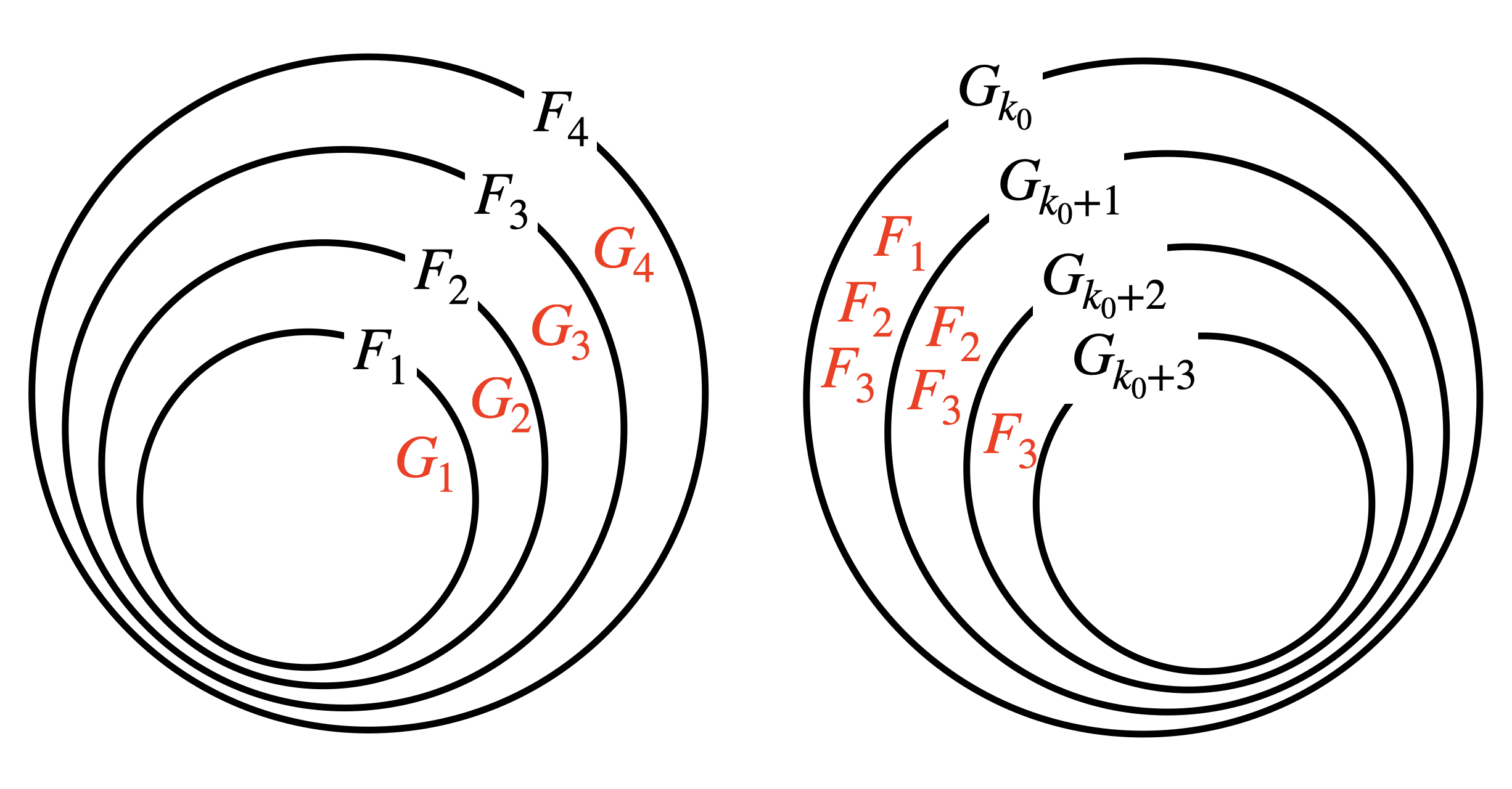
\[\begin{align*} F_{n} \uparrow F &\;\Longleftrightarrow\; F_{n} \subseteq F_{n+1} \;(\forall n \in \mathbb{N}) \;\text{and}\; \bigcup_{n=1}^{\infty} F_{n} = F \\ F_{n} \downarrow F &\;\Longleftrightarrow\; F_{n} \supseteq F_{n+1} \;(\forall n \in \mathbb{N}) \;\text{and}\; \bigcap_{n=1}^{\infty} F_{n} = F \end{align*}\]Lemma 1.2.11(Continuity of measures) Let $(S, \Sigma, \mu)$ be a measure space.
- (a) Suppose $F_{n} \in \Sigma \; (n \in \mathbb{N})$ and $F_{n} \uparrow F$. Then $\mu(F_{n}) \uparrow \mu(F)$.
- (b) Suppose $G_{n} \in \Sigma \; (n \in \mathbb{N})$, $G_{n} \downarrow G$ and $\mu(G_{k_{0}}) < \infty$ for some $k_{0} \in \mathbb{N}$. Then $\mu(G_{n}) \downarrow \mu(G)$.
Proof. Strategy. Construct disjoint sets to use countable additivity.
-
(a) Let $G_{1} = F_{1}$ and $G_{n} = F_{n} \setminus F_{n-1} \; (n \geq 2)$. Then $G_{n} \in \Sigma \; (n \in \mathbb{N})$ and all $G_{n}$’s are disjoint. Moreover,
\[F_{n} = G_{1} \cup \cdots \cup G_{n} = \bigcup_{i=1}^{n}G_{i}, \; F = \bigcup_{i=1}^{\infty} G_{i}\]From the additivity, $\displaystyle{\mu(F_{n}) = \sum_{i=1}^{n}\mu(G_{i})}$. Now take $n \rightarrow \infty$ limit:
\[\lim_{n\rightarrow\infty}\mu(F_{n}) = \sum_{n=1}^{\infty}\mu(G_{n}) = \mu\left(\bigcup_{n=1}^{\infty}G_{n}\right) = \mu(F)\] -
Note. (a) holds only for increasing sequence, but not for decreasing sequence of sets. For instance,
\[\mathrm{Leb}((n, \infty)) = \infty, \; (n, \infty) \downarrow \varnothing \;\text{but}\; \mathrm{Leb}(\varnothing) = 0\]where $\mathrm{Leb}$ denotes Lebesgue measure.
-
(b) We construct increasing sequence of sets. Let $F_{n} = G_{k_{0}} \setminus G_{k_{0} + n} \; (n \in \mathbb{N})$. Now we can apply (a):
\[\begin{align*} \mu(G_{k_{0}}) - \mu(G_{k_{0} + n}) = \mu(F_{n}) &\uparrow \mu(F) \\ &= \mu(G_{k_{0}} \setminus G) = \mu(G_{k_{0}}) - \mu(G) \end{align*}\]$\mu(G_{k_{0}}) < \infty$ implies $\mu(G_{n}) \downarrow \mu(G)$. $\square$
The following is a trivial corollary.
Corollary 1.2.12 The union of a countable $\mu$-null sets is $\mu$-null.
Before we finish, we state alternative way to define measure. In Definition 1.2.2, we have defined measure with the countable additivity. However, we can do similar with countable subadditivity.
Lemma 1.2.13 Let $(S, \Sigma)$ be a measurable space. If set function $\mu : \Sigma \rightarrow [0, \infty]$ satisfies
- (1) $\mu(\varnothing) = 0$
- (2) $\mu$ is finitely additive
- (3) $\mu$ is countably subadditive
then $\mu$ is a measure.
Proof. Let $\lbrace A_{n} \rbrace_{n=1}^{\infty} \subset \Sigma$ be a collection of disjoint sets. We want to show that \(\mu\left(\bigcup_{n=1}^{\infty}A_{n}\right) = \sum_{n=1}^{\infty} \mu(A_{n})\)
- ($\leq$) already satisfied by the countable subadditivity.
-
($\geq$) Split the summation.
\[\begin{align*} \mu\left(\bigcup_{i=1}^{\infty}A_{i}\right) &= \mu\left(\bigcup_{i=1}^{n}A_{i}\right) + \mu\left(\bigcup_{i=n+1}^{\infty}A_{i}\right) \quad (\because \; (2)) \\ &\geq \mu\left(\bigcup_{i=1}^{n}A_{i}\right) = \sum_{i=1}^{n}\mu(A_{i}) \uparrow \sum_{i=1}^{\infty} \mu(A_{i}) \; \text{as} \; n \rightarrow \infty \; \square \end{align*}\]
The following lemma will be used later.
Lemma 1.2.14 Let $(S, \Sigma, \mu)$ be a measure space. Suppose that the sequence of sets $A_{n} \in \Sigma \; (n \in \mathbb{N})$ satisfies $\mu(A_{n}) < \infty$ and $A_{n} \uparrow S$. Define
\[\nu_{n}(B) = \mu(A_{n} \cap B) \quad (\forall B \in \Sigma)\]Show that
- (1) $\nu_{n}$’s are finite measures on $\Sigma$.
- (2) $\displaystyle{\lim_{n\rightarrow\infty}\nu_{n}(B) = \mu(B)}$ for all $B \in \Sigma$.
Proof.
-
(1) Firstly, $\nu_{n}(\varnothing) = \mu(\varnothing \cap A_{n}) = \mu(\varnothing) = 0$. Now let $\lbrace B_{n} \rbrace_{n=1}^{\infty}$ be a collection of disjoint sets. Then
\[\begin{align*} \nu_{n}\left(\bigcup_{i=1}^{\infty}B_{i}\right) &= \mu\left(A_{n} \cap \bigcup_{i=1}^{\infty}B_{i}\right) = \mu\left(\bigcup_{i=1}^{\infty}A_{n} \cap B_{i}\right) \\ &= \sum_{i=1}^{\infty} \mu(A_{n} \cap B_{i}) \quad (\because \; \mu, \;\sigma\text{-additive}) \\ &= \sum_{i=1}^{\infty} \nu_{n}(B_{i}) \end{align*}\]Lastly, $\nu_{n}(S) = \mu(A_{n} \cap S) = \mu(A_{n}) < \infty$. Therefore, $\nu_{n}$’s are finite measures on $\Sigma$.
-
(2) By the continuity of measure(Lemma 1.2.11),
\[\lim_{n\rightarrow\infty}\nu_{n}(B) = \lim_{n\rightarrow\infty}\mu(A_{n} \cap B) \uparrow \mu(S \cap B) = \mu(B) \; \square\]